
Can Our Humanity Survive AI? was a panel discussion that took place on Monday, March 11th, 2024 at the Walsh Family Library in Flom Auditorium. The panelists included Dr. Christiana Zenner, Associate Professor of Theology, Science and Ethics in the Department of Theology at Fordham University, where she is affiliated faculty in Environmental Studies and American Studies, and Dr. Andrea Vicini, is Chairperson, Michael P. Walsh Professor of Bioethics, and Professor of Theological Ethics in the Theology Department at Boston College.
[ Panel Summary ]
Associate Professor of Theology, Science and Ethics in the Department of Theology at Fordham University Dr. Christiana Zenner began the conversation with a review of Asimov’s Three Laws of Robotics in order to frame the discussion about AI. She highlighted AI’s implications for higher education, particularly in an era where social sciences and humanities programs are being defunded. She quoted Dr. Alondra Nelson from the Institute for Advanced Study who underlines the importance of these disciplines in making meaning of technological advancement. Dr. Zenner then discussed the proliferate contexts of inequity and racism within which this advancement has taken place, stating that the uses of technology are only as good as the frameworks within which they are deployed. She then highlighted the environmental and labor impacts of Large Language Models, raising critical questions about biases in knowledge production, labor conditions for employees, and the allocation of crucial energy and water resources which Generative AI requires. Dr. Zenner concluded with an encouragement to turn towards speculative fiction as an epistemological source– particularly towards works written by women and people of color– in order to better attune ourselves to the character and aims of our society in which these technologies take root.
Dr. Andrea Vicini discussed the reflections on technological progress and the developments of artificial intelligence (AI), exploring whether they were perceived as a blessing or a curse. He emphasized the importance of new ethical approaches and resources to tackle the challenges posed by AI to individuals, communities, society, the Church, and the environment. Utilizing theological tradition and ecclesial practices, Dr. Vicini outlined a fourfold approach to address the potential blessings and risks of AI, considering a vision of the person, science, society, and the Church. He highlighted the significance of official teaching and theological reflection in guiding the discernment process, referencing the empowering role of the Pastoral Constitution on the Church in the Modern World, Gaudium et spes. Additionally, he underscored Pope Francis’s involvement in addressing AI challenges, citing ethical principles proposed by the Pontifical Academy for Life and the Dicastery for Culture and Education as guiding factors in discerning the impact of AI. Dr. Vicini concluded by emphasizing the rejection of fear towards AI advancements and the empowerment provided by the Catholic tradition’s theological resources, enabling an informed approach to utilizing AI for the betterment of humanity and society.
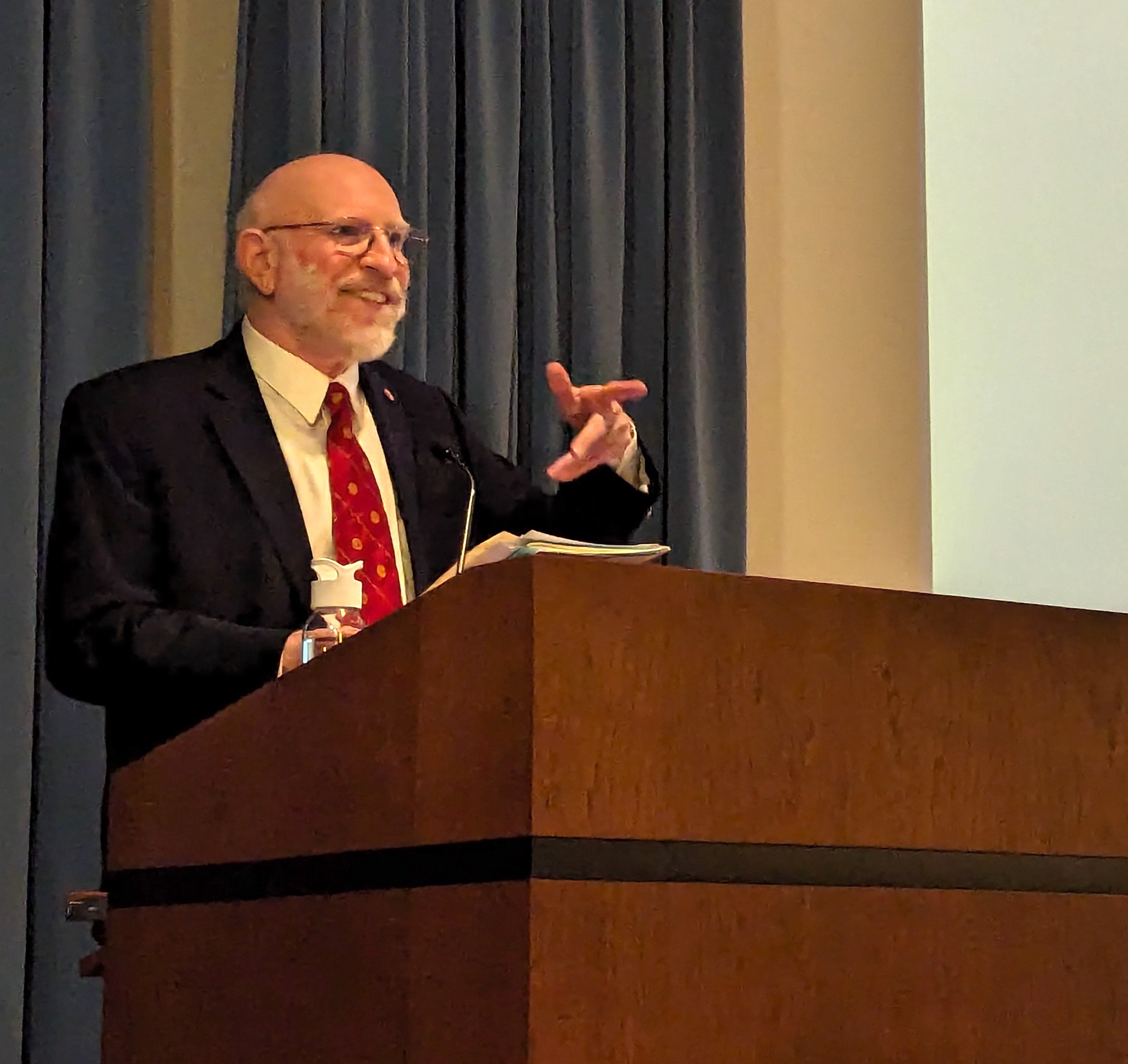
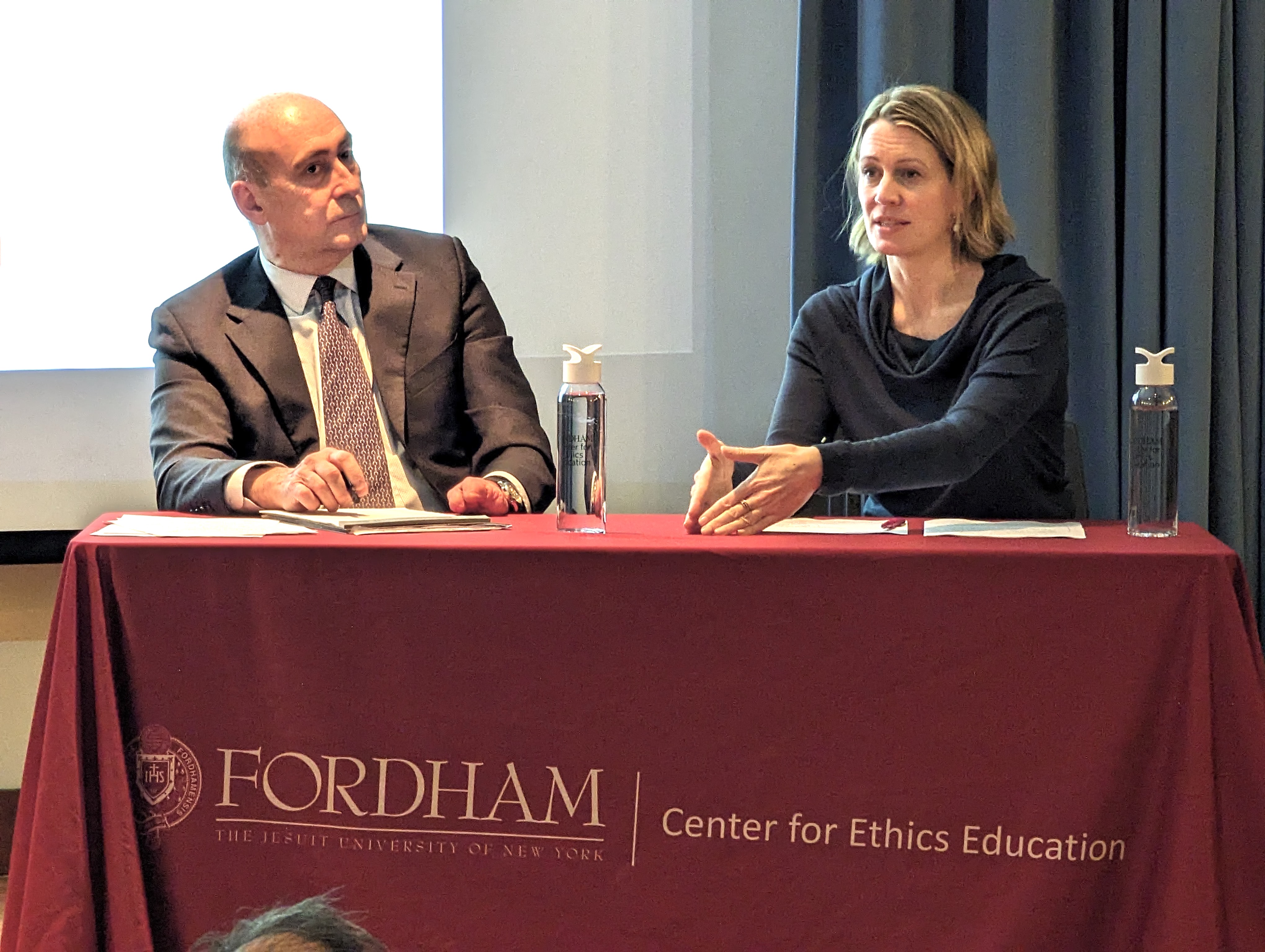

Christiana Zenner, Ph.D. is Associate Professor of Theology, Science, and Ethics and Affiliated Faculty in Environmental Studies at Fordham University-Lincoln Center. She is a scholar of science and religion, focusing especially on modernity’s conceits in ecological science, environmental ethics, and religious ethics. The author of Just Water: Theology, Ethics, and Fresh Water Crises (2014, rev. ed. 2018), Dr. Zenner is also co-editor of two volumes on bioethics, science and society, and sustainability. She has published many peer-reviewed articles, and her public-facing engagements include the Washington Post, the The New Republic, MSNBC, TED-Ed, the New York Times, and Public Radio International. In 2013 she was named one of Microsoft’s “Heroes in Education.” Currently she is teaching one of her favorite classes, “Human Nature After Darwin.” Her next big project is an international collaboration on Planetary Metaphysics through the Berggruen Institute.
Andrea Vicini, SJ, is Chairperson, Michael P. Walsh Professor of Bioethics, and Professor of Theological Ethics in the Theology Department at Boston College. Medical doctor and pediatrician (University of Bologna), he is an alumnus of Boston College (STL and PhD) and holds an STD (Sacred Theology Doctorate) from the Pontifical Faculty of Theology of Southern Italy in Naples. He is co-chair of the international network Catholic Theological Ethics in the World Church. His research interests and publications include theological bioethics, global health, biotechnologies, and environmental issues. In 2015-2016, he had a research fellowship at the Center of Theological Inquiry (Princeton, NJ) on the societal implications of astrobiology. Together with the Artificial Intelligence Research Group for the Centre for Digital Culture of the Dicastery for Culture and Education of the Holy See, he is co-author of the volume Encountering Artificial Intelligence: Ethical and Anthropological Investigations (2024). Other recent publications include three co-edited volumes—Reimagining the Moral Life: On Lisa Sowle Cahill’s Contributions to Christian Ethics (2020), Ethics of Global Public Health: Climate Change, Pollution, and the Health of the Poor (2021), and The Rising Global Cancer Pandemic: Health, Ethics, and Social Justice (2022).
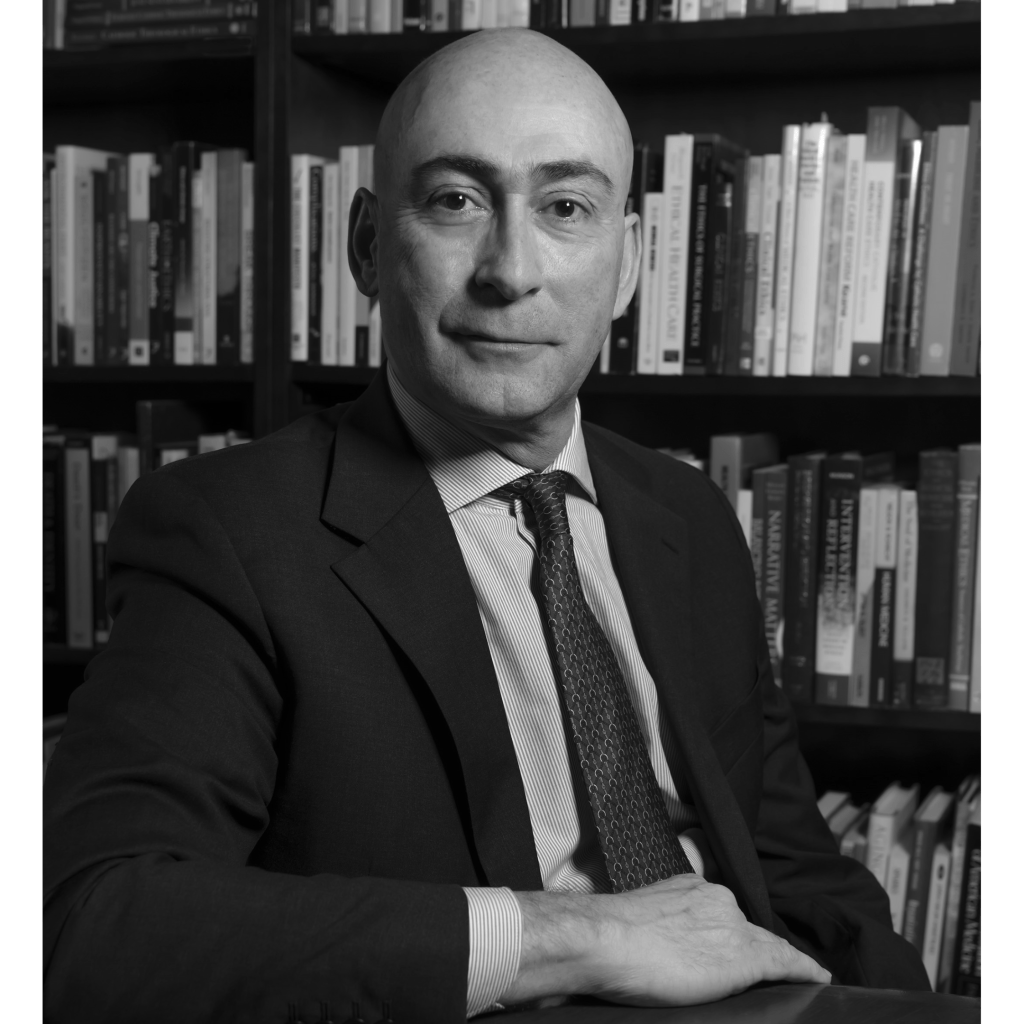
Thomas Massaro, S.J., is Professor of Moral Theology at Fordham University and Associate Director of the Center for Ethics Education. A Jesuit priest, he served as professor of moral theology at Weston Jesuit School of Theology in Cambridge, Massachusetts, at Boston College, and at Jesuit School of Theology of Santa Clara University, where he also served as Dean. His many books and articles are devoted to Catholic social teaching and its recommendations for public policies oriented to economic justice, peace, worker rights and poverty alleviation. His two most recent books are Pope Francis as Moral Leader (from Paulist Press) and Living Justice: Catholic Social Teaching in Action: 4th Classroom Edition (from Rowman and Littlefield) both published in 2023.
To keep updated with the latest posts, please consider subscribing to the The Ethics and Society Blog today!
 The Ethics and Society Blog