STUDENT VOICES | THE 2025 CHYNN ETHICS PAPER PRIZE BEST ESSAY WINNER
Photographing Humanity: When Documentation Becomes Exploitation
By Nadia Garriga – Fordham College, Rose Hill 2027
Last semester, my friends and I decided to take an impromptu trip downtown to explore the Grand Bazaar, a weekly secondhand market. Despite the stifling humidity, the weather conditions were perfect for me to shoot my new film stock. I was ecstatic, ready to put a fresh roll of Kodak Gold to good use. As I walked through the mazes of leather-filled clothing racks and smoke-stained posters, an old man sitting under an array of scaffolding caught my attention. Without hesitation, I grabbed my film camera and adjusted the shutter speed. Click. I forgot about him as quickly as I had noticed and went about my day.
Later that month, I stood on the corner of Essex and Hester and skimmed through my freshly developed photo scans. Slowly, I made my way towards the forgotten mystery man’s photo. Upon first glance, it seemed great. I even debated dropping it into my portfolio. As I stared at the familiar scaffolding and brick, something felt off. Once I looked past the underexposure and harsh shadows, I realized that the man wasn’t a passerby, but an unhoused individual seeking to escape the early September heat. As I began to notice his bags of personal belongings and his worn-down facial expression, a guilty feeling began to sink into my chest. I had invaded this man’s personal space, and in the act of taking the photo, manipulated a greater dynamic between the two of us.
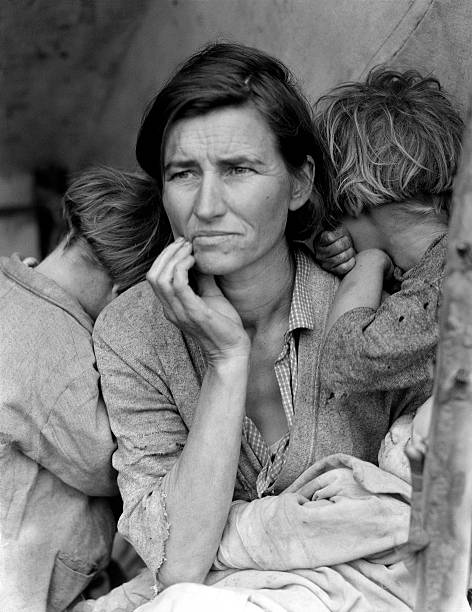
This idea of exploitation within photography wasn’t entirely new to me. I learned about the concept in my “History of Photography” course, where we discussed how infamous images, while valuable, often partook in subject exploitation. Examples included Dorothea Lange’s “Migrant Mother” photo and Robert Frank’s photobook “The Americans”, both of which captured American poverty throughout the mid-20th century. These works, and countless others, documented the harsh conditions of post-war America, but at the expense of their subjects. While Lange and Frank found financial, professional, and social success through their work, their subjects received no financial compensation and did not consent to be photographed (Pruitt, 2020).
While it’s tempting to dismiss these transgressions as something of the past, the reality is that photographers have a constant ethical duty to the subjects of our photographs, specifically towards their dignity and innate human rights. This paper discusses the ethical framework surrounding this responsibility, its rationale, and the power dynamics that embody the relationship between photographer and subjects. It’s compelling to dismiss the term “photographer” as a professional title, reserved for careers and experts. For the purposes of this paper, I extend the title to anyone who has access to a camera, whether professional-grade or limited to a cell phone, as this best embodies the accessibility of modern photography and the collective nature of this responsibility.
Trying to formulate why our photographic subjects are owed an ethical duty is admittedly difficult. After all, respecting others ought to be intrinsic to our human nature. Conveniently, this ethos is the foundation of humanism, a secular philosophy that will guide the following arguments.
Originating from the Italian Renaissance, humanism believes that humanity’s value and morality are derived not from divine beings, but from human experience, reasoning, and logic (Zagorin, 2003). Since its founding, the ideology has grown to take on new meanings concerning human values and interests. While there are many facets of humanism to examine, this paper focuses on one specific quality: dignity. Broadly speaking, dignity is a basic worth that is equally assigned to all human beings (Debes, 2023). Because we share this value, we should uphold each other’s dignity to sustain progress and rationality, especially through mutual recognition of each other’s humanity (Stephen Law, 2011).
Humanism recognizes dignity as intangible to humanity, and therefore free from divine ruling or religious influence. Yet, for the purposes of understanding ethical responsibility in a photographer-subject relationship, I propose taking this idea a step further. If humanism maintains that people have innate dignity, then it’s not only divine doctrines that cannot impede this right, but other humans themselves. To uphold humanism’s end goal of maximizing human potential, dignity must be nurtured, meaning that no individual can exercise unjust power over another, as this threatens an individual’s perception of their own worth.
Applying this philosophy to photography provides the ethical foundation for exploring the power dynamics and the resulting tension between a photographer and their subject. Even the phrasing of “their subject” conveys images of authority, crossing the boundary between creative partnership and ownership. When somebody takes a photo, they control the narrative through their creative decision-making. In some cases, a subject’s awareness of this power, consent to being photographed, and the possible benefits of having their photo taken confer a level of authority to the subject. Ideally, this renders photographers and subjects on a more even playing field, diminishing the possibility of exploitation and upholding their individual dignity.
However, in many cases, a lack of transparency and compensation leaves the subject relatively powerless in their relationship with the photographer. Suddenly, the photographer is in a position of authority over the subject and capable of exercising unchecked power over how the subject is presented. This evades the subject’s personal autonomy throughout the creative process and diminishes their intrinsic value as a person, creating an ethical violation under the humanist perspective.
Additionally, consolidating narrative control solely in the photographer’s hands risks falling into the trap of sensationalism, in which the pursuit of capturing reality is suddenly tainted by what the photographer chooses to see, rather than what the subject actually experiences. From this, a multifaceted human being is reduced to a single moment within a frame, deprived of their own perspective and, additionally, of their own value. Reduction brings about powerlessness, once again creating unbalanced dynamics between photographers and subjects that violate a humanist conception of dignity and personal fulfillment.
After a long period of reflection, I realized my photographer-subject relationship with the mystery man fell into this category. He was off guard, sweltering in the sunlight, and trying to escape the brutal urban heat. I was fully conscious, holding the camera that I had the privilege of owning, and relieved that I’d have an air-conditioned apartment to return to. I did not ask him for permission to take his photo or inform him of my intent with the picture. I did not get to know him or his story. Instead, I imposed my vision of who he was, ignoring his autonomy and rendering him obsolete within his own narrative. In that moment, the mystery man’s dignity depended on how I chose to frame him, upholding the authority granted to me by my own socioeconomic privilege. These arbitrary definitions of status didn’t grant me divine or innate power over the man, and yet our dynamic, and so many other photographer-subject relationships, uphold this power structure. When these structures become exploited, the subject’s personal value and dignity are reduced.
Despite my persistence against these structures, I’m cautious to assert that all photographer-subject relationships are entirely exploitative. In making this claim, we risk demonizing visual evidence as a whole and discrediting its contribution to documenting humanity. Some of the most thought-provoking and raw photography of our time resulted from a photographer’s impromptu, spur-of-the-moment shots, taken without consideration for the ethical implications. Pragmatically, it’s not possible to constantly communicate your actions, thought processes, or intentions to your subject.
Take, for example, war photographers, who’ve shed light on major human rights violations, influenced political policy, and produced visual evidence for future generations. Capturing these fast-paced moments creates an environment where photographer-subject communication is near impossible, leaving the judgment of the moment to the photographers. This takes the subject’s narrative control away, placing the responsibility on the photographer instead. Here, we’ve fallen into the same power dynamic previously criticized, but does the context surrounding this scenario change the ethical expectations? Would humanism denounce war photography for its exploitative tendencies, or would it support it for the policy changes and human rights awareness that it produces, shifting humanity closer to fulfillment? Countless “what-if” scenarios challenge humanist ethics in photography. I won’t insist that it’s possible to evaluate the power dynamics of every photographer-subject relationship thoroughly before shooting a photo. However, we, not just as photographers but as human observers, owe a commitment to upholding the dignity of our fellow people to the best of our ability. Between built-in cell phone cameras and new models constantly hitting the market, access to photography has never been easier. But with this accessibility comes a social responsibility to consider how our artistic endeavors may come at the cost of someone else’s humanity. Coming to terms with my own unethical decision-making regarding this topic brought me to this conclusion, and as uncomfortable as it feels, this accountability carries with it personal growth, responsibility, and an understanding of how our individual powers exist within a greater, human-centric ecosystem.
For more information about the prize, past winners, and submission requirements for 2027, please visit the Chynn Ethics Paper Prize webpage. The deadline to submit is March 2027 and the competition is open to ALL undergraduates.

Nadia Garriga is a member of Fordham College Rose Hill’s class of 2027, pursuing a major in New Media & Digital Design with double minors in Political Science and Italian.
References
Debes, R. (2023, February 18). Dignity. Retrieved from Stanford Encyclopedia of Philosophy
website: https://plato.stanford.edu/entries/dignity/
Lange, D. (1936). Migrant Mother [Film]. In Library of Congress. Retrieved from
https://guides.loc.gov/migrant-mother/images
Law, S. (2011). Introduction: what is humanism? Humanism: A Very Short Introduction.
https://doi.org/10.1093/actrade/9780199553648.003.0001
Pruitt, S. (2020, May 8). The Real Story Behind the “Migrant Mother” in the Great
Depression-Era Photo | HISTORY. Retrieved from HISTORY website:
https://www.history.com/articles/migrant-mother-new-deal-great-depression
Zagorin, P. (2003, October). on humanism past & present. Retrieved from American Academy of
Arts & Sciences website:
https://www.amacad.org/publication/daedalus/humanism-past-present

